
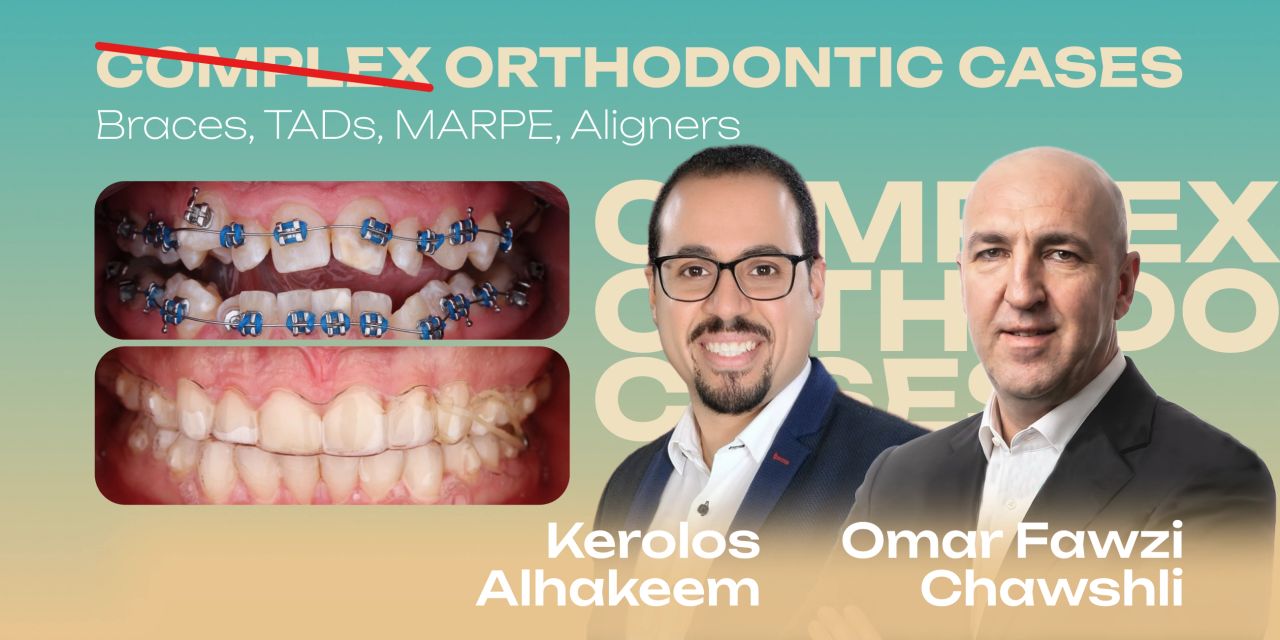
Digital Workflow for Palatal Miniscrew Appliances and MARPE

Digital Workflow for Palatal Miniscrew Appliances and MARPE
Kerolos AlhakeemBài học có trong các khóa học sau:
Nhận khóa học này và 1 200 giờ học với Premium.
bao gồm những gì
Bài học này
Chi tiết
46phút
0.75 Tín chỉ CE

Tiếng Anh
Quyền xem bản ghi trong thời hạn gói Premium của bạn
Chương trình bài học
– The clinical and logistical benefits of transitioning to a digital orthodontic workflow
– Limitations of the conventional analog approach
– Complication analysis: a clinical case of incorrect palatal miniscrew positioning and its consequences
– Digital problem-solving: clinical challenges resolved by a completely digital workflow
– Limitations of maxillary expansion
– Architectural anatomy of the facial skeleton
– Identifying structures of resistance against skeletal maxillary expansion
– Biomechanical comparison: skeletal vs. conventional tooth-borne anchorage
– Midpalatal suture maturation: classification and the clinical decision-making hierarchy
– Comprehensive analysis of the stages of midpalatal suture maturation
– Clinical relevance of maturation stages: establishing age-appropriate treatment pathways
– Crucial intraoral clinical examination prior to skeletal expansion
– Diagnostic matrices for crowding cases
– Assessing and diagnosing functional mandibular shifts
– Utilizing the WALA Ridge for mandibular arch form diagnostics
– Classification of Miniscrew-Assisted Rapid Palatal Expansion (MARPE)
– Biomechanical differences: bone-borne (BB) vs. tooth-bone-borne (TBB) appliances
– Finite element analysis: stress distribution and displacement patterns of different palatal expanders
– The ""TAD-First"" vs. ""TAD-Last"" fabrication protocol
– Biomechanical stability: monocortical vs. bicortical skeletal anchorage
– Anatomical guidelines and safe zones for miniscrew insertion in palatal sites
– Core components and architecture of the digital orthodontic workflow
– Advanced imaging: segmentation, orientation, and fusion of cephalometric and CBCT data
– Three-dimensional anatomical evaluation and virtual placement of palatal TADs
– CAD/CAM software design for 3D-printed surgical guides
– Clinical protocol: placing palatal TADs using a 3D-printed surgical guide
– Laboratory and chairside protocols for bonding the skeletal appliance
– Comprehensive, step-by-step clinical case analyses and troubleshooting.
Bài học có trong các khóa học sau: