
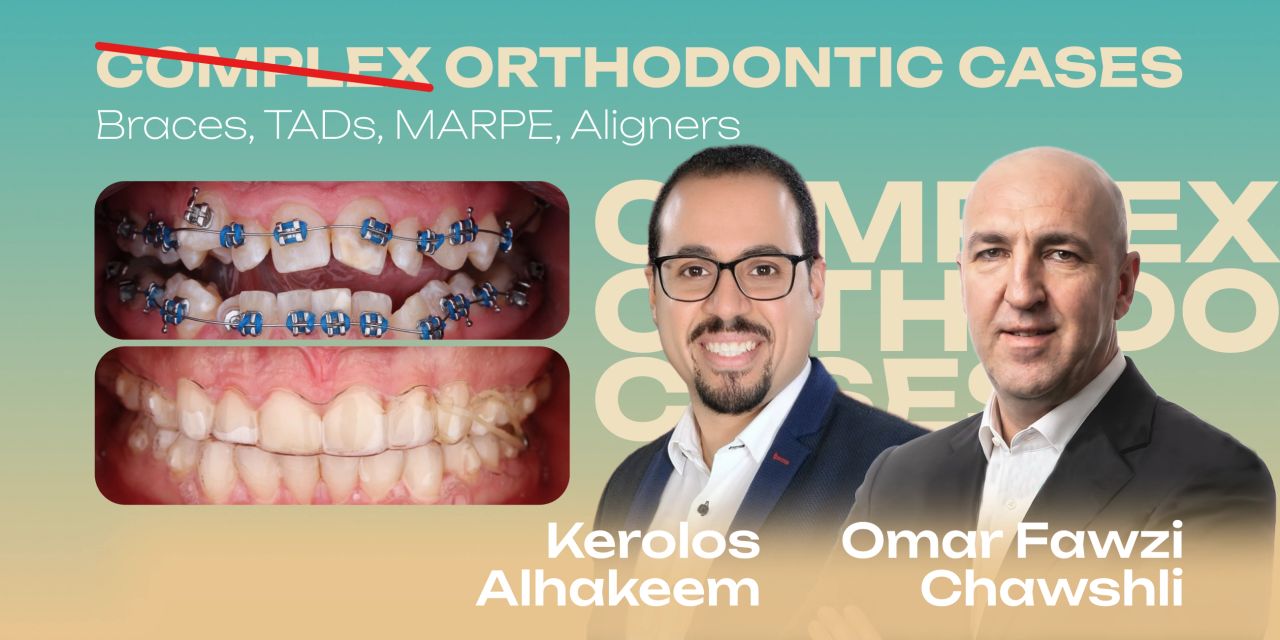
Hybrid Aligner Mechanics in Orthodontic Treatment

Hybrid Aligner Mechanics in Orthodontic Treatment
Kerolos AlhakeemBài học có trong các khóa học sau:
Nhận khóa học này và 1 200 giờ học với Premium.
bao gồm những gì
Bài học này
Chi tiết
58phút
0.75 Tín chỉ CE

Tiếng Anh
Quyền xem bản ghi trong thời hạn gói Premium của bạn
Chương trình bài học
– Mechanical principles: how clear aligners move teeth
– The biomechanical concepts behind aligners: force delivery mechanisms
– Comparative analysis: clear aligners vs. fixed appliances
– Open vs. closed orthodontic systems and strategies for space gaining
– The clinical role of aligner attachments
– The tracking and engagement dilemma in aligner therapy
– Determining the force vectors and active push surfaces of an aligner
– Biomechanics of buccolingual tipping
– The 3 fundamental pillars of success in clear aligner therapy
– Aligner manufacturing: types of polymers
– Material science: physical characteristics of thermoplastic polymers
– Aligner biomechanics as dictated by material properties
– Evaluating movement type predictability
– Clinical efficacy: how effective are aligners at true tooth movement?
– Biomechanics of mesiodistal tipping
– What aligners can and cannot achieve
– Clinical guidelines for software overcorrection
– How to improve aligner predictability
– Hybrid mechanics: the synergy of buttons and elastics
– Strategic placement of elastic attachments for maximum efficiency
– Class 2 management: anchorage control in bilateral Class 2 Division 1 malocclusions (clinical case)
– Class 2 management: midline shift correction in unilateral Class 2 Division 1 malocclusions (clinical case)
– Class 3 management: anchorage control and mechanics in reverse overjet/anterior crossbite (clinical case)
– High-angle cases: managing vertical discrepancies, extrusion, and settling protocols (clinical case)
– The push-pull dynamic: mastering advanced directional forces (clinical case)
– Biomechanical limitations of rotational movements in aligner therapy
– Hybrid derotation techniques: integrating minitubes and sectional NiTi wires (clinical case).
Bài học có trong các khóa học sau: