
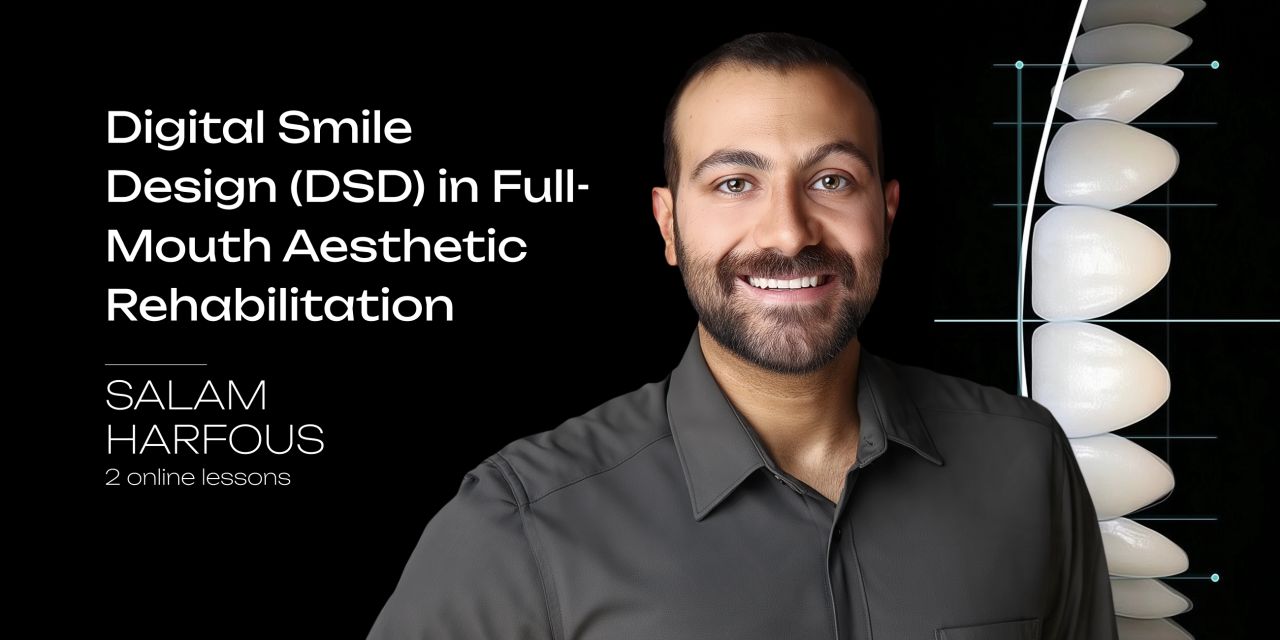
DSD Philosophy, Facial Aesthetics, and AI-Driven Analysis

DSD Philosophy, Facial Aesthetics, and AI-Driven Analysis
Salam HarfoushBài học có trong các khóa học sau:
Nhận khóa học này và 1 200 giờ học với Premium.
bao gồm những gì
Bài học này
Chi tiết
36phút
0.5 Tín chỉ CE

Tiếng Anh
Quyền xem bản ghi trong thời hạn gói Premium của bạn
Chương trình bài học
This lesson explores why digital smile design is a clinical language rather than a simple software application. You will analyze the fundamental reasons dentists hesitate to adopt digital workflows, review the step-by-step DSD protocol, and clarify the division of responsibilities between the clinician and the dental technician. The lesson details why models that look perfect in software can fail aesthetically in vivo, demonstrating how to align software algorithms and Golden Proportion rules with real facial landmarks, incisal edge positioning, and individual patient proportions.
— Key barriers: 2 reasons clinicians remain stuck in conventional workflows and avoid digital adoption
— Comprehensive overview of the end-to-end Digital Smile Design (DSD) workflow
— Division of responsibilities: defining the roles of the dentist vs. the dental technician in digital design
— Clinical translation: comparing software mock-ups with clinically adjusted intraoral designs
— The vital role of the silicone index in achieving predictable final restorations
— Intraoral vs. model discrepancies: why software-perfect smiles fail on the patient's face
— Facial parameters and aesthetics: critical evaluation of the Golden Proportion in real-world dentistry
— Individualized design: how DSD calculates individual patient proportions and facial symmetry
— Software mechanics: how digital algorithms operate using literature criteria and AI tools
— Diagnostic sequencing: initial situation analysis and predictable final result visualization
— Treatment initiation: determining incisal edge position, reference ranges, and facial shape morphology.
Bài học có trong các khóa học sau: