
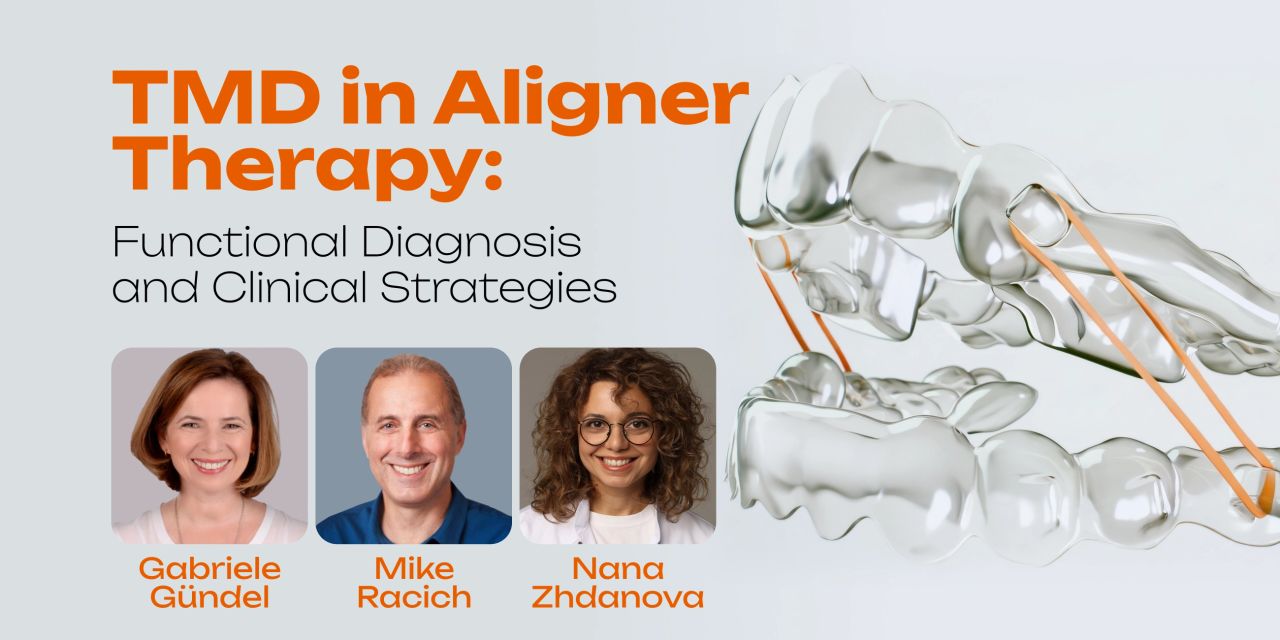
TMD in Aligner Therapy: Functional Diagnosis and Clinical Strategies
A clinical approach to managing TMD patients with aligners — from TMJ assessment and functional joint positioning to treatment planning, occlusal control, and retention.


TMD in Aligner Therapy: Functional Diagnosis and Clinical Strategies
Nana Gezalova, Mike Racich, Gabriele GündelKhóa học gồm các bài học sau:
Nhận khóa học này và 2 800 giờ học với Premium.
bao gồm những gì
Khóa học trực tuyến này
Chi tiết
4 bài học (2giờ 59phút)
2.5 Tín chỉ CE

Tiếng Anh
Quyền xem bản ghi trong thời hạn gói Premium của bạn
Mô tả
This course provides a clinically focused approach to the diagnosis, treatment planning, and orthodontic management of patients with temporomandibular disorders (TMD) using aligner therapy.
During the course, you will learn about:
– Fundamentals of TMD and the biopsychosocial approach to diagnosis
– Relationship between occlusion, joint position, and TMD development
– Functional Aligner Therapy with Spark Aligners
– Management of patients transitioning from splint therapy to aligner treatment
– Prevention and management of occlusal discrepancies, including posterior open bite
– Management of TMJ-related pain and complications during aligner therapy
– Occlusal control and stabilization of the condylar position throughout treatment
– Clinical decision-making, treatment planning, and analysis of real patient cases
– The role and limitations of aligners during the retention phase in TMD patients.
By the end of the course, participants will be able to assess TMD-related risk factors, establish an appropriate functional starting position, plan aligner treatment around TMJ considerations, and manage occlusion and condylar stability throughout treatment.
Bài học 1.Functional Joint Space and Aging Jaws: Understanding TMD Development and Treatment
– Relationship between occlusal contacts, condylar position, and TMJ function
– Effects of malocclusion and disc displacement on the joint space
– Mechanisms and consequences of progressive joint-space narrowing
– Physiological aging changes of the jaws beginning around the age of 30
– Age-related changes in condylar position and joint morphology
– Symptoms and prevalence associated with aging jaws
– Relationship between aging jaws, malocclusion, and TMJ dysfunction
– Potential progression from physiological changes to temporomandibular disorders (TMD)
– Clinical assessment of the TMJ and joint space in orthodontic diagnosis
– Functional considerations for orthodontic treatment planning.
Bài học 2.Functional Aligner Therapy with Spark Aligners: A Treatment Concept for Patients with Temporomandibular Disorders (TMD)
– Determining and establishing the physiological condylar position
– Functional splint therapy and stabilization of the TMJ
– Transfer of the physiological joint position into Spark Approver
– Functional Aligner Therapy with Spark Aligners
– Spark features for maintaining condylar position during tooth movement
– Achieving functional occlusion while maintaining TMJ stability.
Bài học 3.Fundamentals of TMD in Orthodontics
– Modern concepts of TMD and the biopsychosocial model
– Differential diagnosis of muscular and joint-related disorders
– TMJ clicking, joint noises, and degenerative changes
– Occlusion and its role in orthodontic diagnosis and TMD management
– TMD screening, documentation, and medico-legal considerations
– Phased treatment protocol: diagnosis, stabilization, orthodontics, and retention
– Indications, limitations, and contraindications for aligner therapy in TMD
– Integration of aligners with physiotherapy and multidisciplinary care
– Occlusal control and TMD management throughout treatment
– Clinical checklists for orthodontic treatment of TMD patients.
Bài học 4.TMD Considerations and Clinical Strategies in Aligner Therapy
– Prevention and management of occlusal discrepancies, including posterior open bite
– Diagnosis and management of TMJ-related complications and pain during aligner therapy
– Aligner treatment following splint therapy
– Clinical methods for determining centric relation
– Treatment planning and step-by-step analysis of clinical cases.
Khóa học gồm các bài học sau: