
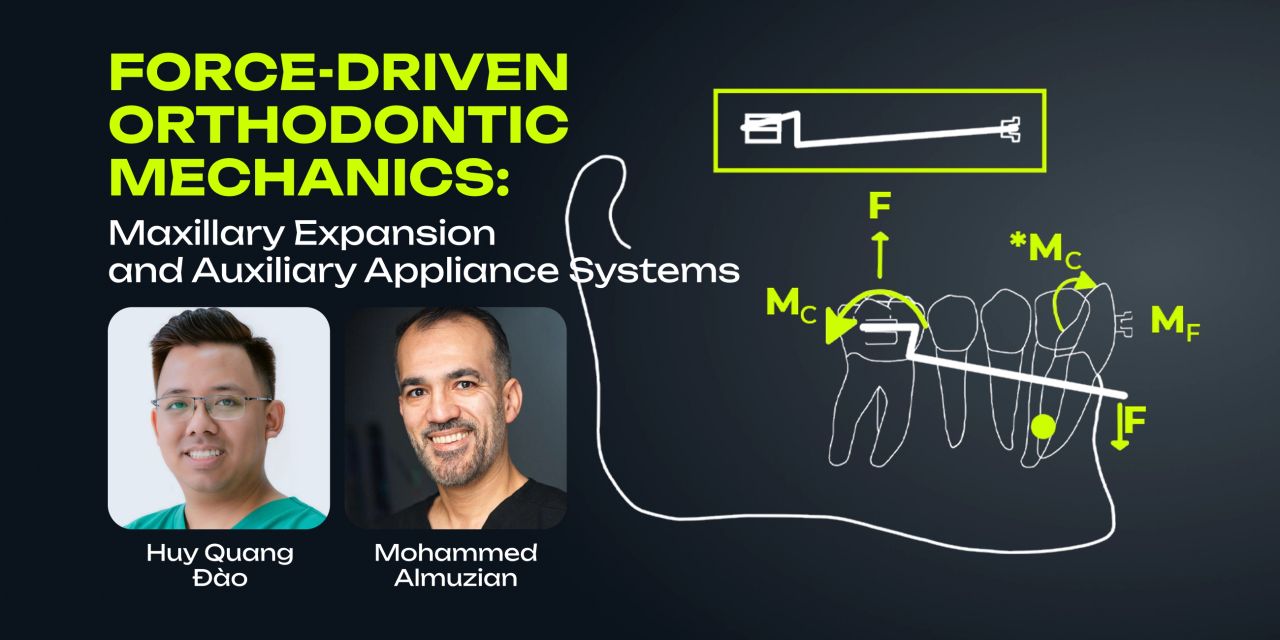
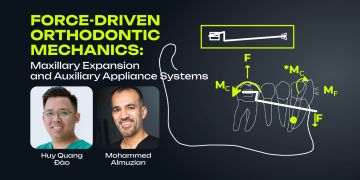
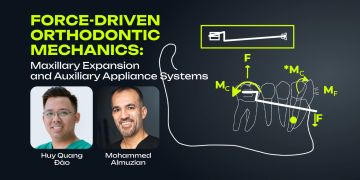
Force-Driven Orthodontic Mechanics: Maxillary Expansion and Auxiliary Appliance Systems
Step-by-step activation, bonding, and design protocols of various auxiliary appliances with real clinical case applications.


Force-Driven Orthodontic Mechanics: Maxillary Expansion and Auxiliary Appliance Systems
Huy Quang Đào, Mo AlmuzianKhóa học gồm các bài học sau:
Nhận khóa học này và 1 200 giờ học với Premium.
bao gồm những gì
Khóa học trực tuyến này
Chi tiết
6 bài học (3giờ 24phút)
Chứng chỉ quốc tế OHI-S
2.75 Tín chỉ CE

Tiếng Anh
Quyền xem bản ghi trong thời hạn gói Premium của bạn
Mô tả
Explore force–driven orthodontic mechanics with a focus on maxillary expansion, transverse correction, and auxiliary appliance systems, bridging classical orthodontic principles with modern evidence–based protocols.
Participants will gain a deep understanding of the biomechanics behind RME appliances, transpalatal arches, quad helices, Nance appliances, and the Ricketts utility arch.
During the course, you will learn about:
– Design, bonding, and activation protocols for rapid maxillary expansion (RME)
– Clinical decision-making for expansion timing in growing and adult patients
– Biomechanics and application of transpalatal arches, quad helices, and Nance appliances
– Segmental maxillary distalization using the Ricketts utility sectional arch
– Force systems, center of resistance, and control of unwanted side effects
– Activation protocols and compensatory mechanics in utility arch systems.
By the end of the course, you will be able to design and execute predictable biomechanics and force-driven mechanics for efficient orthodontic treatment.
Bài học 1.Maxillary Expanders: History and Clinical Use
– Historical context and evolution of maxillary expanders
– Clinical and theoretical concepts of maxillary expansion
– Determining the required amount of expansion in different clinical cases
– Mode of actions of RME
– Design characteristics of rapid maxillary expanders
– Evidence supporting different expansion protocols
– Clinical application and customization of expander design.
Bài học 2.Design, Bonding Protocols, and Activation Protocols for Rapid Maxillary Expansion
– Design options for rapid maxillary expanders (RME)
– Working with CAD/CAM RME
– Bonding and banding protocols of RME
– Activation protocols for effective expansion
– Protocols for Class 3 malocclusion cases
– Timing of rapid maxillary expansion based on age and dental development
– Case study analysis of different protocol approaches
– Personalized planning for timing and activation in clinical practice.
Bài học 3.Adult Expansion and Risks: Controversies and Updates in Maxillary Expansion
– Challenges of maxillary expansion in adult patients
– Risks and complications of adult maxillary expansion
– Latest research and updates on expansion techniques
– Controversies and differing clinical viewpoints
– Risk mitigation strategies in adult cases
– Application of updated knowledge for improved safety and outcomes.
Bài học 4.Transpalatal Arches, Quad Helices, and Nance Appliances: Modern Orthodontic Tools
– Functional roles of transpalatal arches, quad helices, and Nance appliances
– Advantages and disadvantages of different appliances
– Clinical indications and contraindications
– Design variations and customization options of transpalatal arches, quad helices, and Nance appliances
– Case analysis of appliance use in orthodontic treatment
– Integration of appliances into treatment planning best practices.
Bài học 5.Segmental Distalization of the Maxilla Using Ricketts Utility Sectional Arch
– Force vectors and defining the center of resistance
– Analysis of the side effects of different distalization protocols
– The design of the Ricketts utility sectional arch
– Distalization with Class II elastics and application of third-order bends
– Application of the Ricketts utility sectional arch with miniscrews
– Video demonstrations: step-by-step protocols of wire bending and fabrication of the Ricketts utility sectional arch
– Side effects of distalization and application of the Ricketts utility sectional arch: correction protocols.
Bài học 6.Activation Protocols and Clinical Applications of the Ricketts Utility Arch
– Protocols of specific activation components
– Anchorage with toe-in activation bend of the Ricketts utility sectional arch
– Management of inclination and angulation with compensatory bends on the utility arch and application of intermaxillary elastics
– Analysis of clinical cases.
Khóa học gồm các bài học sau: