

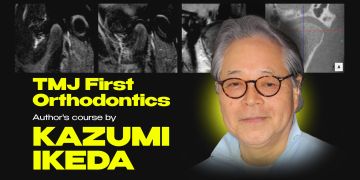
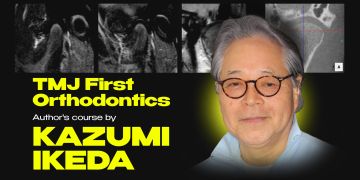
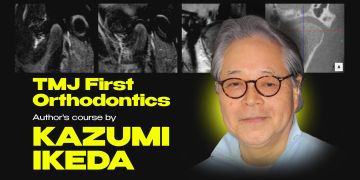
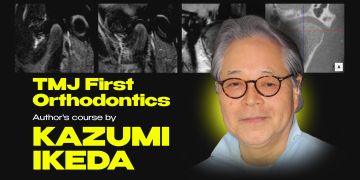
TMJ First Orthodontics. Author's course by Kazumi Ikeda

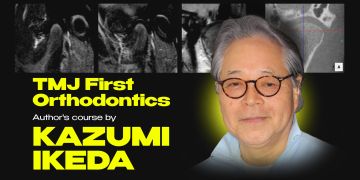
TMJ First Orthodontics. Author's course by Kazumi Ikeda
Kazumi IkedaKhóa học gồm các bài học sau:
Nhận khóa học này và 2 800 giờ học với Premium.
bao gồm những gì
Khóa học trực tuyến này
Chi tiết
5 bài học + 1 miễn phí (8giờ 35phút)
Chứng chỉ quốc tế OHI-S
6.75 Tín chỉ CE

Tiếng Anh
Quyền xem bản ghi trong thời hạn gói Premium của bạn
Mô tả
TMJ-first approach and treatment mechanics to achieve functional mandibular stability post-orthodontic therapy in the protocols of Dr. Kazumi Ikeda!
This course offers 30+ years of the author’s clinical experience and insight into the relationship between TMJ health, mandibular growth, and orthodontic treatment.
You will learn in detail about:
– Protocols for working with the TMJ-first approach in orthodontics
– The role of the mandibular position in orthodontic treatment planning
– Protocols for managing the mandibular position prior to orthodontic treatment
– Diagnostic tools in clinical practice: CBCT and MRI
– Protocols for assessing and managing disc displacement.
The course includes both theory and demonstrations of numerous clinical cases treated with the TMJ-first Orthodontics approach developed by Dr. Kazumi Ikeda!
Bài học 1.Diagnosing Mandibular Position: Key Considerations and Techniques
– Challenges in assessing mandibular position during the initial visit
– Understanding 3D mandibular discrepancies
– Stable vs. unstable mandibular positions
– Diagnostic tools in clinical practice: CBCT and MRI
– Special considerations for referred cases and their treatment analysis.
Recommended for: Orthodontists, Functional dentists, General dentists.
Bài học 2.Stabilizing Mandibular Position Before Orthodontic Treatment
– Identifying a stable mandibular position for effective treatment planning
– Understanding TMJ conditions and recognizing normal TMJ images
– Addressing TMJ instability before initiating orthodontic treatment
– The role of muscle relaxation in obtaining an accurate mandibular position
– Strategies for resolving 3D mandibular discrepancies before treatment.
Recommended for: Orthodontists, Functional dentists, General dentists.
Bài học 3.Assessing and Managing Disc Displacement
– The importance of the TMJ in mandibular stabilization
– Disc displacement (D.D.) as the most common TMJ issue
– Prevalence of D.D. in growing patients seeking orthodontic treatment
– Potential for progressive changes in the TMJ due to D.D.
– Analysis of the stages of D.D. and assessment of the patient's current condition
– Protocols for the management of D.D.
– Evaluating the optimal timing for splint therapy and orthodontic intervention.
Recommended for: Orthodontists, Functional dentists, General dentists.
Bài học 4.Integrating 3D Mandibular Discrepancies into Orthodontic Treatment Planning
– Mandibular discrepancies in treatment planning
– The significance of vertical discrepancies
– Protocols for identifying and addressing lateral discrepancies
– Prioritizing the correction of 3D mandibular discrepancies
– Protocols of developing a treatment plan based on an actual case study.
Recommended for: Orthodontists, Functional dentists, General dentists.
Bài học 5.Biomechanics for Mandibular Position Stability
– The role of mandibular position in orthodontic treatment planning
– Key features of Roth treatment mechanics
– The significance of torque in the straight wire treatment approach
– Roth’s modifications to Andrews’ straight wire technique and its impact on occlusion
– Biomechanics: the efficiency of en-masse movement for anterior teeth alignment
– The importance of vertical control in the molar region for mandibular stability
– Analysis of clinical cases: applying TMJ-First mechanics in treatment planning.
Recommended for: Orthodontists, Functional dentists, General dentists.
Bài học 6.Aesthetic and Functional Orthodontic Treatment Approach
– Role of the growth of the mandible in facial aesthetics
– Importance of functional TMJ in achieving facial harmony
– Impact of growth-period problems on the TMJ
– Consequences of TMJ issues on facial appearance
– Long-term benefits of balanced orthodontic outcomes for aesthetics and function
– Analysis of Roth’s five treatment goals
– Protocols for achieving functional occlusion
– Analysis of TMJ movement and occlusion stability.
Recommended for: Orthodontists, Functional dentists, General dentists.
Khóa học gồm các bài học sau: