
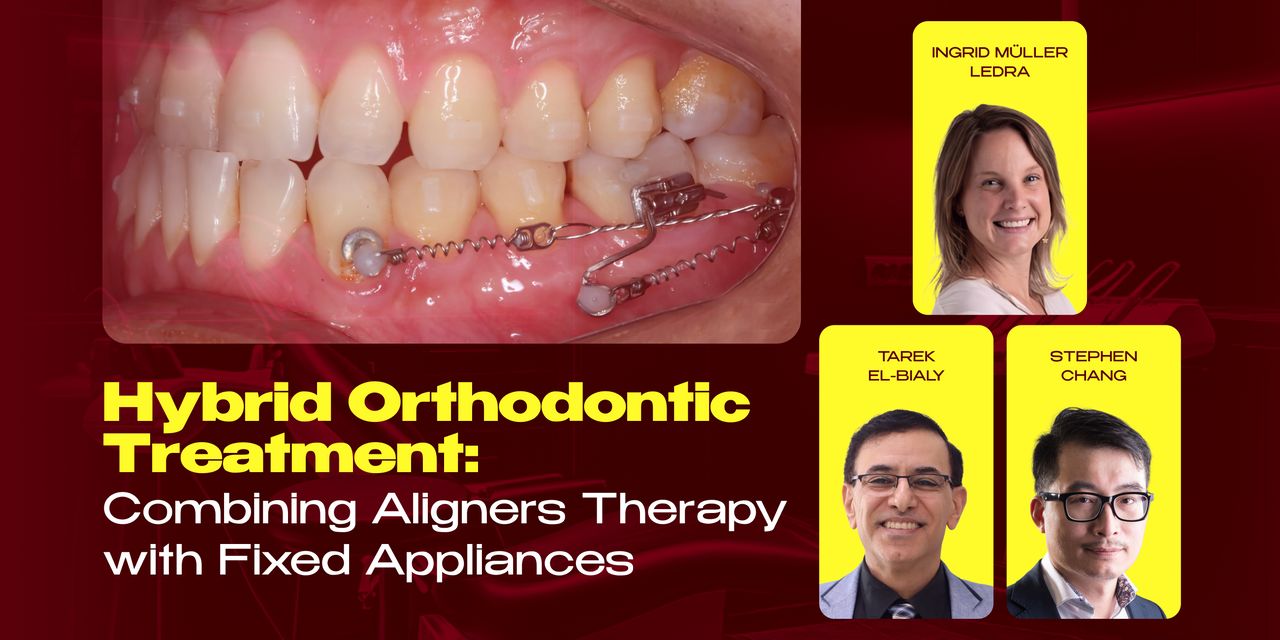
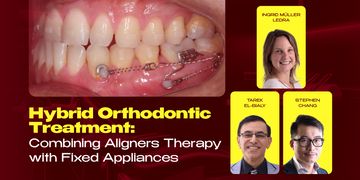
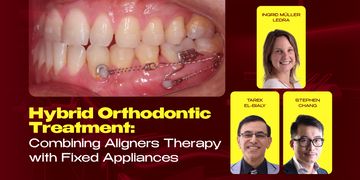
Hybrid Orthodontic Treatment: Combining Aligners Therapy with Fixed Appliances


Hybrid Orthodontic Treatment: Combining Aligners Therapy with Fixed Appliances
Tarek El-Bialy, Ingrid Müller Ledra, Stephen ChangKhóa học gồm các bài học sau:
Nhận khóa học này và 2 800 giờ học với Premium.
bao gồm những gì
Khóa học trực tuyến này
Chi tiết
6 bài học (5giờ 41phút)
4.75 Tín chỉ CE

Tiếng Anh
Quyền xem bản ghi trong thời hạn gói Premium của bạn
Mô tả
All the solutions and biomechanics to overcome unpredictable movements and treat complex malocclusions with clear aligners!
The hybrid approach is designed to combine the best of both worlds — clear aligners and fixed appliances — to address complex orthodontic challenges.
Dr. Tarek El-Bialy, Ingrid Müller Ledra, and Stephen Chang will guide you on how integrating fixed appliances with aligners allows for more controlled and predictable tooth movements, especially in cases with significant malocclusions or limitations in aligner therapy.
During the course, you will learn about:
– Biomechanics of the hybrid approach
– Aligner therapy in combination with sectional bracket systems
– Aligner therapy with TADs and other fixed orthodontic appliances
– Treatment of complex malocclusions, including crossbite and camouflage of Class 2 and Class 3.
Bài học 1.Aligners and Brackets: Clinical Decisions in Hybrid Mechanics
– Defining clinical cases for hybrid mechanics
– Strategic advantages of hybrid mechanics for complex malocclusions and anchorage
– Treatment planning of hybrid mechanics cases
– Integrating both brackets and aligners in different stages of treatment
– Predictable tooth mobility and controlled treatment outcomes.
Recommended for: Orthodontists, General dentists.
Bài học 2.Hybrid Mechanics in Orthodontics: Case Selection, Treatment Strategies, and Challenges
– Case selection criteria for hybrid approaches
– Clinical scenarios that benefit from hybrid mechanics, including factors such as patient compliance, biomechanics, and treatment goals
– Challenges in hybrid mechanics and troubleshooting issues
– Minimizing treatment time with hybrid mechanics
– Patient expectations and treatment fees in hybrid treatments.
Recommended for: Orthodontists, General dentists.
Bài học 3.Hybrid Mechanics for Greater Efficiency with Aligners
– Protocols for integrating auxiliary mechanics to enhance complex movements in aligner treatments
– The biomechanics behind hybrid approaches to aligner therapy
– Approaches to significantly reduce treatment time using flexible hybrid methods for precision
– Protocols for integrating TADs to improve control and achieve difficult movements
– Approaches to increase predictability and control by combining aligners with braces and fixed appliances.
Recommended for: Orthodontists, General dentists.
Bài học 4.Optimizing Hybrid Orthodontic Treatments: Protocols and Approaches
– Limitations of clear aligners and fixed appliances: Challenges and how to address them in complex cases
– Key tools to accurately assess and plan hybrid orthodontic treatments
– Protocols for deciding whether fixed appliances or aligners should come first in complex cases
– Approaches for achieving predictable movements with aligners and fixed appliances
– Protocols for effective space closure with hybrid treatments
– Protocols for bodily movement of second molars using both braces and aligners.
Recommended for: Orthodontists, General dentists.
Bài học 5.Simplifying Complex Orthodontic Cases with Wilson 3-D Appliance and Clear Aligners
– Protocols for using the Wilson 3D appliance as a phase I tool to expand arches and align teeth prior to clear aligner treatment
– Approach to managing impacted teeth with the Wilson 3D appliance to facilitate their movement before aligner use
– Protocols for using the Wilson 3D multiaction palatal appliance to relieve upper arch crowding before aligners
– Approach to correcting posterior crossbite with the Wilson 3D multiaction palatal appliance prior to aligner therapy
– Application of the Wilson 3D palatal appliance to expand the upper arch and correct class II malocclusion before clear aligners
– Protocols for aligning lower incisors using the Wilson 3D lower lingual appliance before clear aligners.
Recommended for: Orthodontists, General dentists.
Bài học 6.The Hybrid Aligner-TADs-Wire Approach (HTAWA) for Class III Malocclusion Treatment
– Why use hybrid aligner-wire techniques?
– The biomechanics of Class III malocclusion treatment with a hybrid aligner approach
– Non-extraction protocol in Class III camouflage treatment with clear aligner therapy using hybrid protocols
– Extraction protocol in Class III camouflage treatment with clear aligner therapy using hybrid protocols
– Finishing and detailing aligner therapy.
Recommended for: Orthodontists, General dentists.
Khóa học gồm các bài học sau: